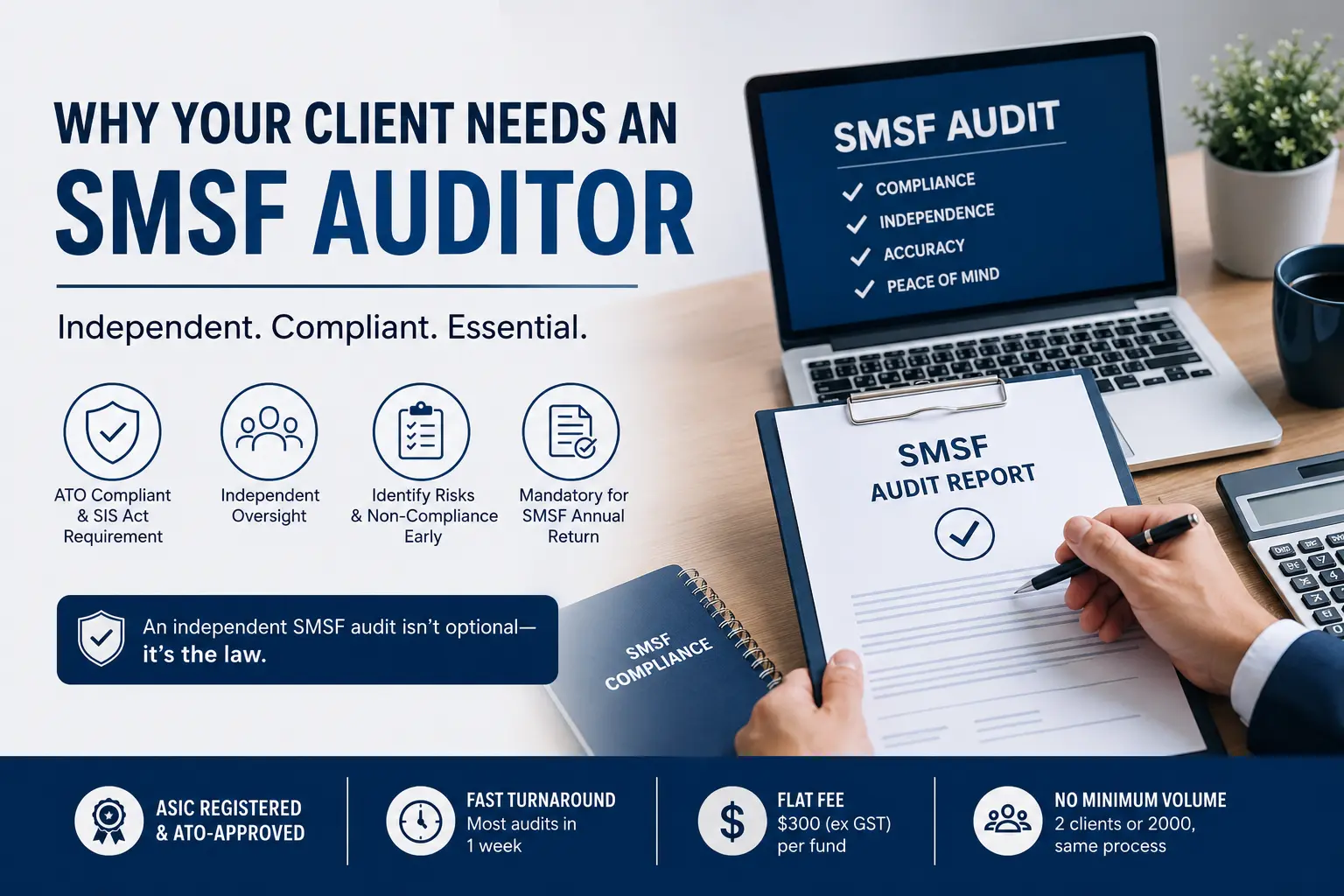
Do you really need an SMSF Auditor? The short answer is yes. If your client holds a self-managed super fund, an independent annual audit isn’t optional. It’s a statutory requirement under the Superannuation Industry (Supervision) Act 1993 (SIS Act). Without a signed audit report from an ASIC-registered auditor, the fund’s annual return cannot be lodged with the ATO.
Yet few accounting and financial planning firms still treat the audit as an afterthought, leaving it to generalist auditors who aren’t across the nuances of SMSF compliance. That’s where the real risk lies.
Why the Auditor Must Be Independent of Your Firm?
This is where many accounting firms face a compliance risk they underestimate. Under APES 110 (the Code of Ethics for Professional Accountants), an auditor cannot be independent if they are involved in preparing the financial statements of the same fund. If your firm both prepares the SMSF financials and signs off on the audit, you are in breach of independence requirements, regardless of how carefully the work is separated internally.
The ATO is actively monitoring this. Firms that audit their own clients’ SMSFs risk regulatory action, and in serious cases, deregistration of the auditor involved. Outsourcing the audit to a dedicated, independent SMSF audit firm removes this risk entirely and gives your clients the clean, defensible audit report their annual return requires.
Why an Approved SMSF Auditor Is Essential?
All SMSF members and trustees move forward with a vision to grow wealth and enjoy tax concessions. However, to enjoy these benefits is not as easy as it seems. There are strict rules set by the Superannuation Industry (Supervision) Act 1993 (SIS Act), and only an approved and registered SMSF auditor can provide the required independent oversight.
- Checking whether your client’s fund investments and withdrawals follow the SIS Act and ATO regulations
- Identifying compliance breaches so they can be addressed before they escalate
- Providing the independent report that is legally required to lodge the SMSF annual return
However, it’s important to remember that an auditor’s job is to review and report, not to fix mistakes or guarantee compliance. If there are breaches, the responsibility to correct them lies with the trustee, typically with support from their accountant or administrator.
The Expertise That Keeps Your Clients on Track
An ATO-approved SMSF auditor stays up to date with the latest superannuation and tax law changes and can quickly catch mistakes before they become bigger problems. For example, if a client has made an investment under the influence of other trustees or advisers and it turns out to be non-compliant, a specialist auditor can identify this issue and report it, allowing your client to act quickly and avoid escalating consequences.
Funds must be audited every year, regardless of whether the client needs full-time financial support. Annual auditing ensures no accumulating issues go undetected over time. For your firm, this also means fewer surprise compliance issues landing in your lap at lodgement time.
How the Audit Process Works?
The whole audit process is broken into four steps that ensure your client’s fund complies with ATO requirements:
- Engagement – You engage a registered SMSF auditor on behalf of your client (or refer the client directly). An engagement letter is issued outlining the scope and responsibilities.
- Document Collection – You or your client’s administrator provides the required documentation, including bank statements, investment records, contributions, and pension details.
- Audit Review: The auditor reviews the fund’s financials and compliance status against Australian Auditing Standards and SIS Act requirements.
- Report: An independent audit report is issued, which must be lodged with the SMSF annual return.
Most of this process can now be handled online, making it fast and straightforward for both your firm and the auditor.
Key Benefits for Your Firm and Your Clients
Partnering with an independent SMSF auditor delivers clear benefits on both sides:
- Stays legally compliant – An audit is required by the ATO; without it, your client’s SMSF return cannot be lodged.
- Identifies weaknesses early – The audit highlights areas where the fund may be breaching rules or carrying compliance risk, giving time to remediate.
- Peace of mind – Your client knows their SMSF has been reviewed by a qualified, independent professional.
- Clear path to resolution – If a breach is found, a detailed report means your client knows exactly what needs fixing.
- Protects your firm’s independence – Using an external auditor eliminates any self-review threat under APES 110, keeping your firm compliant with professional standards.
- Predictable costs – A flat-fee audit structure means you can price your service to clients without uncertainty.
Why Choose SMSF Audits Pty Ltd?
At SMSF Audits Pty Ltd, we specialise exclusively in independent SMSF audits for accounting and financial planning firms across Australia.
- We are fully approved by the ATO and registered with ASIC
- We use streamlined processes for quick turnaround, and most audits are completed within one week
- We help identify issues early so your clients can correct them before they escalate
- Flat fee of $300 per fund (ex GST) – regardless of fund size or complexity, with no hidden charges. In an exceptional case where an ACR needs to be lodged, then $100 plus GST extra fees are applicable.
- APES 110 compliant – fully independent from your firm’s accounting and advisory services
- No minimum volume – whether you have 2 SMSF clients or 2000, the process and pricing are the same
To get started, you don’t need to visit our office. By simply arranging a brief virtual meeting, you can set up the audit process for your clients and keep them compliant with ATO requirements.
Frequently Asked Questions
Question 1. What happens if an SMSF skips its annual audit?
Answer: By skipping an audit, the trustee will be in breach of their obligations. The ATO may impose penalties, delay processing the return, or take compliance action against the fund.
Question 2. What does an SMSF audit cost?
Answer: At SMSF Audits Pty Ltd, the fee is a flat $300 per fund (ex GST), regardless of size or complexity. In the rare event an Audit Contravention Report (ACR) is required, an additional $100 (ex GST) applies.
Question 3. Can an SMSF auditor prevent ATO penalties?
Answer: No, an auditor cannot prevent penalties or fix breaches. Their role is to identify and report issues; remediation is the trustee’s responsibility.
Question 4. What documents are needed for the audit?
Answer: Bank statements, contribution records, pension payment details, investment purchase and sale documents, and any other supporting information about the fund’s transactions.
Question 5. How long does an SMSF audit take?
Answer: Most audits are completed within one week of receiving all required documentation. Delays typically happen when documentation is incomplete, so providing bank statements, investment records, and pension details upfront helps keep the turnaround fast.
Question 6. Can I use the same auditor every year?
Answer: Yes, and in fact it’s often beneficial to do so. A consistent auditor becomes familiar with the fund’s history and investment structure, which can make each year’s audit faster and help spot unusual changes more easily. The independence requirement only restricts using an auditor connected to your firm, not using the same external auditor annually.
Question 7. What triggers an Audit Contravention Report (ACR)?
Answer: An ACR is lodged when the auditor identifies a breach of the SIS Act that meets ATO reporting thresholds, such as loans to members, exceeding contribution caps, or prohibited related-party transactions. Not every minor or corrected breach requires an ACR; the auditor assesses each case against ATO guidelines.
Question 8. Does my firm need a separate auditor for each SMSF client, or can one auditor handle multiple funds?
Answer: One independent SMSF auditor can handle audits for all of your firm’s SMSF clients, regardless of how many funds you manage. This is one of the advantages of outsourcing to a dedicated SMSF audit firm: you get one consistent point of contact instead of managing multiple relationships.